
Unmasking Autism Masking
How to diagnose authentic lives.
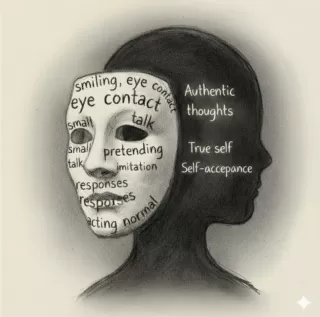
Source: Lloyd, D. & Light, A. (2025). Masking Authentic Self and Autism. Google Gemini [Generative AI].
Key points
- Since COVID-19, mental health difficulties in children have increased 35% in the UK, and there is a shortage of child psychologists.
- Instead of face-to-face therapy for a child, which can be hard to access, indirect Parent Consultations are effective and have many benefits.
- An increase in Parent Consultations could significantly reduce wait times for children to be seen directly for talking therapy.
In episode 10 of the Breaking Through Therapy Podcast, we spoke with autism coach “Alfi” and clinical psychologist Katie Adolphus—who assessed Alfi for autism some years ago. Alfi shared her journey with autism and the process of unmasking and self-discovery. For many people with autism, life is a balancing act between being true to their authentic selves and being accepted. This delicate dance often takes the form of “masking”.
n recent years, awareness and diagnoses of autism have grown—by one estimate, diagnoses rose 787% between 1998 and 2018 (Russel et al., 2021). Research has shown that autistic people are more likely to experience co-occurring mental and physical health conditions such as anxiety and depression (Lai et al., 2019) and even gastrointestinal disorders and seizures (Sala et al., 2020). These challenges come not only from autism but from the pressure to mask it. Understanding this has allowed for quality-of-life improvements for people with autism, giving them a better grasp of themselves and how to manage their daily lives.
Adolphus describes masking as “the conscious and unconscious things that people do to squash down the differences and make them less apparent to the world”. At a surface level, we all mask from time to time, altering our behaviours to fit a social dynamic, such as at a wedding or a business meeting. However, as autism coach Alfi explained on the podcast, there is a critical difference:
- Everyday adjustments can be as simple as lowering your voice in a library.
- Masking in autism is suppressing your true self, communication style, and identity so that others will accept you.
Masking in autism isn’t just exhausting; it can be debilitating. Beginning as early as childhood, autistic children learn that their honesty and directness can be punished, regardless of how good their intentions are. Over time, they begin to hide parts of themselves to avoid misunderstanding, rejection, or punishment.
Alfi shared an example from her school days that demonstrates how easily misunderstandings can happen. During a particularly noisy class, when the teacher asked “Who is talking?”, taking the question literally, Alfi raised her hand—resulting in detention as punishment. Not understanding how correctly answering a question got her in trouble, she asked, “Why?” This question resulted in further punishment and eventually being labelled a ‘challenging’ kid.
Why People Mask
Alfi reflected on how there wasn’t a specific moment in time where she became aware that she was different; instead she always tried her best to ‘fit in’. Her natural behaviours were frequently classed as ‘weird’ or ‘challenging,’ which reinforced a sense of otherness. Over time, these comments can eat away at a person’s self-esteem and create confusion about how to behave in different scenarios.
Continuing into adulthood and the workplace, an autistic person might learn to stay quiet about ideas and/or opinions to avoid upsetting others. (A demonstration of this behaviour can be seen in the fable “The Emperor’s New Clothes”—a tale of knowing the truth but feeling unable to speak it.)
Getting a Diagnosis
While masking can help a person navigate their daily life, the lasting effects can be detrimental. For example, it can sometimes leave autistic people with questions like “I need to find out what’s going on because I’m the common denominator”. This results in exhaustion, burnout, and a heightened sensitivity to rejection with no clear explanation.
For Alfi, an autism assessment wasn’t just about getting a diagnostic label; it was a way for her to understand why she felt different. Adolphus described the process of getting an assessment as a way to “lower the shoulders”.
This process can help shed labels such as ‘rude’ or ‘awkward’ that may have been built over time. Perhaps most importantly, an assessment can help an autistic individual learn to ‘un-mask’ and live an authentic life. They can gain a better understanding of their identity, and help to better define who they are, all while removing the desire to suppress themselves for other people’s comfort.
Alfi has used her life experience of being a midwife, governance lead, and HR manager to improve her own and others’ lives through her current and future work. The knowledge gained from her diagnosis set a foundation for achievements including getting a master’s degree in adult autism and becoming an ADHD and autism coach and consultant. She aims to further expand her knowledge by completing a Ph.D. in autistic epistemology.
There may still be some stigma around the autism label, but many people in the autistic community feel they are able to achieve more through the deeper self-awareness and knowledge an assessment brings, living a full and authentic life with unmasked self-expression.
Authors
Co-authored by Dean Lloyd and Alice Light, Honorary Research Assistants at Lifespan Psychology—The Diverse Practice in London.
References
Lai, M. C., Kassee, C., Besney, R., Bonato, S., Hull, L., Mandy, W., … & Ameis, S. H. (2019). Prevalence of co-occurring mental health diagnoses in the autism population: a systematic review and meta-analysis. The Lancet Psychiatry, 6(10), 819-829.
Russell, G., Stapley, S., Newlove-Delgado, T., Salmon, A., White, R., Warren, F., Pearson, A., & Ford, T. (2022). Time trends in autism diagnosis over 20 years: a UK population-based cohort study. Journal of child psychology and psychiatry, and allied disciplines, 63(6), 674–682. doi.org/10.1111/jcpp.13505
Sala, R., Amet, L., Blagojevic-Stokic, N., Shattock, P., & Whiteley, P. (2020). Bridging the gap between physical health and autism spectrum disorder. Neuropsychiatric Disease and Treatment, 1605-1618.
SHARE