
The 12 Steps to Faith, Connection, and Recovery
A journey through trauma, addiction, and post-traumatic growth.
Beth Ashley-Smith, a trauma addiction and ADHD psychotherapist, and her former client ‘Rob’ joined us on a recent episode of our Breaking Through Therapy podcast. The client-therapist duo spoke about addiction, PTSD and recovery. In the UK, over 310,000 people were treated for addiction-related issues between 2023/2024, highlighting the prevalence of addiction (Office for Health Improvement and Disparities, 2024).
Trauma affects the body and mind and harms identities and faith. People with traumatic and painful experiences are more likely to waver in their faith in a power higher than the addiction. However, through a 12-step programme, group connections and individual psychotherapy, Rob overcame his addiction and rediscovered his faith. For him, this was the beginning of post-traumatic growth (PTG).
Trauma and Faith
Rob, a war correspondent and journalist, was reporting on the tsunami that ravaged Thailand in 2004. Being exposed to large-scale death, pain, and grief on that assignment, he found himself consumed by rage at God for letting this happen. This resulted in a degraded relationship with religion and the start of a newly-formed connection with alcohol.
There was a period of denial about the impact of the trauma for Rob. Anger and drinking eventually led him to seek mental health support after a 5-year self-destructive spiral, during which time he met Beth who addressed his fear and anger through inpatient treatment, group support and direct communication with clear boundaries in psychotherapy.
Trauma can disrupt a person’s identity and belief systems. Many individuals experiencing PTSD report feelings of disconnection from themselves and their faith. Some note the impossible nature of making sense of the trauma. Addressing this disconnection is critical.
This fractured sense of faith led the way for addiction to take over as a new ‘God’ in the wake of a fragmented mental state. Without acknowledging and accepting this shift, seeking help to repair belief systems and identity is an uphill battle.
Community and Recovery
The 12 steps represent a structured recovery process in which individuals admit their problems, receive support and find forgiveness, to reduce dependency on the addiction. When Rob began his recovery journey, he joined an Alcoholics Anonymous group and began his exploration of the programme. This allowed him to understand and accept his condition, whilst maintaining support and camaraderie through fellow members.
The programme emphasises connection and purpose, building on skills to repair defense mechanisms and healthy relationships, while reinforcing support networks. Group therapy allowed Rob to take up space in an environment encompassed with compassion and accountability.
This group work provided a greater purpose, aided by support and love he could not receive elsewhere. The role of group discussions within the programme is associated with better outcomes (Donovan et al., 2013), which can be seen through Rob’s journey and his drive to, as he says, “try everything no matter how silly or unrelated” he believed a task to be.
The communal aspects of the programme strengthen the spiritual dimensions. Feeling a part of something outside of themselves provides a sense of connection to the individual’s faith and community, which reinforces recovery.
Spirituality was a key part of Rob’s journey to recovery. The programme relies on shifting from a central focus on substances to something larger, and there is no fixed definition of that, which allows an individual to define spirituality in their own terms.
Rebuilding Meaning
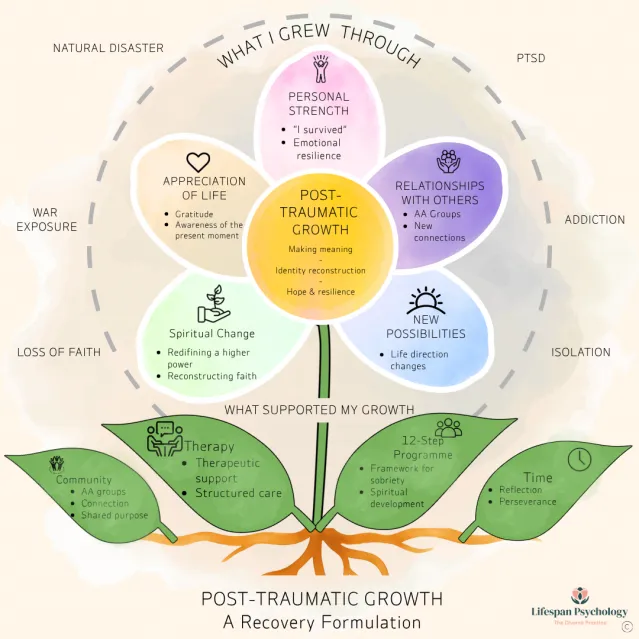
Recovery from trauma and addiction is not linear, often involving setbacks, relapses and doubt. Positive outcomes can emerge through post-traumatic growth (PTG), a psychological change following recovery from a traumatic event. Identifying areas where you can improve while acknowledging your strengths, you can find a greater appreciation for life, closer relationships, and a plan for future possibilities.
Tedeschi and Calhoun (2009) explain the five core domains of PTG: appreciating life, relationships with others, personal strength, new possibilities, and spiritual change. All five factors are accounted for in the Post Traumatic Growth Inventory, an outcome measure used to assess quality of life in those who have experienced traumatic events.
With the right support, these challenges pave the way for new perspectives. Lorenzi et al (2022) highlight the contextual factors that influence the experience of distress or growth, reinforcing the importance of supportive interventions within recovery. Instead of returning to our faith as we once knew it, a personal and deeper understanding is developed. In this way, trauma does not just fracture our faith, but reshapes and strengthens it.
Since completing treatment, Rob has continued to focus on his growth by travelling across the country, telling his story of trauma, addiction and recovery to affected communities.
Credits
Co-authored by Alice Light and Dean Lloyd, Honorary Research Assistants at Lifespan Psychology—The Diverse Practice in London. This article originally appeared on Psychology Today.
References
Cole, E. (2025, February 10). Spirituality: How To Stay Sober with PTSD from War and Natural Disaster (No. 5) [Podcast Spirituality: How To Stay Sober with PTSD from War and Natural Disaster]. Spotify.
Tedeschi, R. G., & Calhoun, L. G. (2009). The clinician as expert companion. In C. L. Park, S. C. Lechner, M. H. Antoni, & A. L. Stanton (Eds.), Medical illness and positive life change: Can crisis lead to personal transformation? (pp. 215–235). American Psychological Association. doi.org/10.1037/11854-012
Donovan, D. M., Ingalsbe, M. H., Benbow, J., & Daley, D. C. (2013). 12-Step Interventions and Mutual Support Programs for Substance Use Disorders: An Overview. Social Work in Public Health, 28, 313. doi.org/10.1080/19371918.2013.774663
National Center for PTSD. (n.d.). Spirituality and meaning making after trauma. U.S. Department of Veterans Affairs. ptsd.va.gov/professional/treat/care/toolkits/clergy/spiritualityMeaning.asp?utm_source=chatgpt.com
Office for health improvement and disparities (2024, November 28). Adult substance misuse treatment statistics 2023 to 2024: report. GOV.UK. gov.uk/government/statistics/substance-misuse-treatment-for-adults-statistics-2023-to-2024/adult-substance-misuse-treatment-statistics-2023-to-2024-report
SHARE